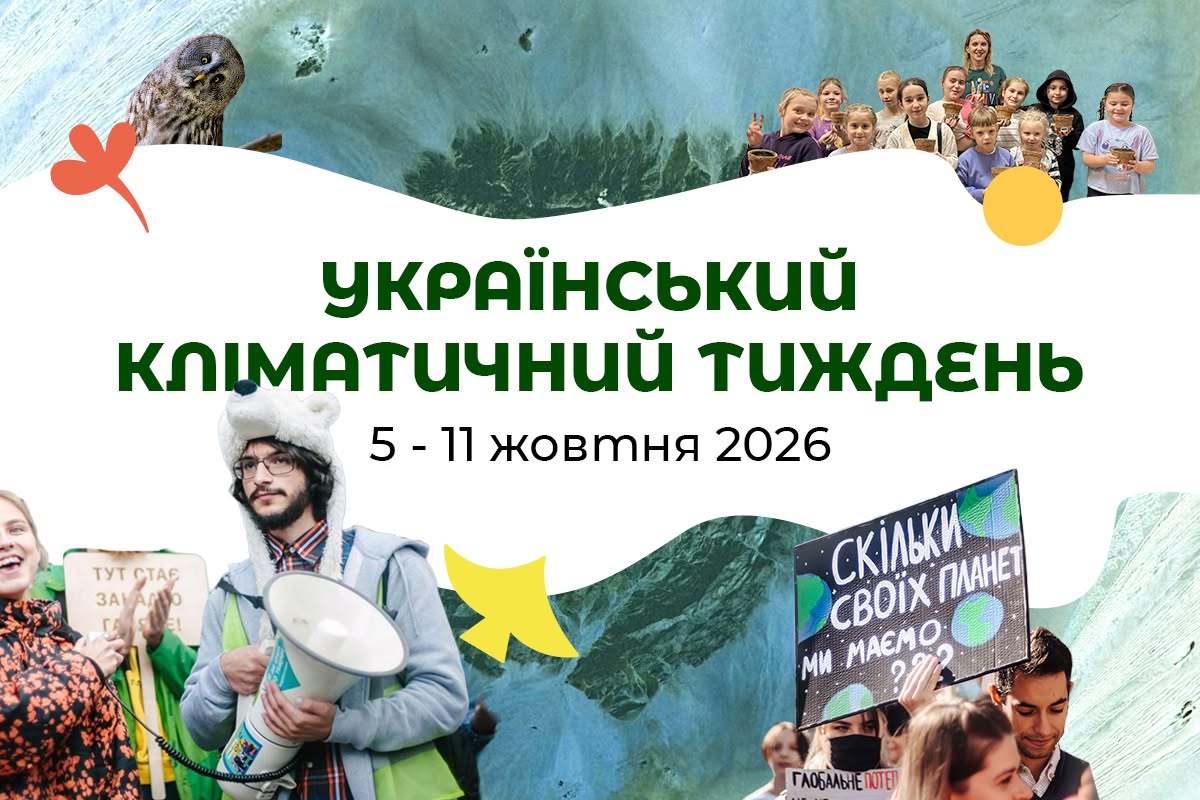
From October 5 to 11, the Ukrainian Climate Week (UCW) will take place across Ukraine for the second time — a nationwide marathon of events on climate change, community adaptation, energy security, and green recovery. Anyone can become part of it: all you need to do is organise a climate-related event and add it to the UCW network (conditions below).
A lecture or discussion, an open lesson at school, an eco-game, a film screening, a community clean-up, an exhibition, a workshop, or a campaign — organisers are free to choose their own format. The main requirement is that the event helps spark conversation about the climate crisis and the solutions that can be implemented today.
This year, the Ukrainian Climate Week centres on the connection between climate change and various aspects of our lives. The organisers aim to show that climate solutions are not only about protecting the environment, but also about energy security, inclusivity, education, and the rebuilding of Ukraine.
Russia’s devastating war causes massive damage to Ukraine’s environment every day and intensifies climate challenges across the world. At the same time, the decisions Ukraine makes today in the fields of energy, urban and community reconstruction, transport, and natural resource use will determine their resilience for decades to come.
This is why the UCW organisers are calling on citizens, local authorities, educational institutions, civil society organisations, media, and responsible businesses to join forces.
“A week of awareness about the climate crisis is not only a practice of democratic countries that we want to make a tradition in Ukraine. It is an opportunity to show how much climate change already affects different areas of our lives, especially in the context of war, which intensifies these challenges. Our main call is to act: to adapt to the changes already taking place, and at the same time to reduce humanity’s impact on the climate.”
— Anna Talash, Local Initiatives Development Coordinator at Greenpeace Ukraine.
How to Join the UCW?
Citizens, civil society organisations and initiatives, local self-government bodies, educational institutions, media, and responsible businesses can all join the Ukrainian Climate Week.
To participate:
Come up with and organise a climate-related event;
Adhere to the values of the Ukrainian Climate Week — including the principles of non-discrimination, environmental responsibility, and the absence of greenwashing;
Register your event via the Ukrainian Climate Week registration form;
Hold it between October 5–11 in your community or online.
After registration, your event will become part of the all-Ukrainian marathon.
About the UCW
The Ukrainian Climate Week was first held in 2025. That year, approximately 150 events took place across different regions of Ukraine, bringing together more than 5,000 participants. In 2026, the organisers aim to expand the geography of the initiative and involve even more communities, organisations, educational institutions, and local initiatives.
The Ukrainian Climate Week was founded by pro-climate and environmental civil society organisations: Greenpeace Ukraine, Ecodia, Rozviy, Ukrainian Climate Network, Ukrainian Nature Conservation Group, StarDub, Fridays For Future Ukraine, U-Cycle, and the Holosiivskyi National Nature Park.
You can register your own event via the UCW form: Register here
Schoolchildren today hear quite often about climate change, environmental pollution, and the need to sort waste. But between knowing about environmental problems and understanding what can actually be done in one’s own school, yard, or city, there remains a significant gap. This gap is exactly what the “Green School” project set out to narrow — implemented by the NGO “Krokivnia” in Bila Tserkva. Its core idea: to show young people that eco-friendly habits are a practical tool for working with the urban environment. Project participants talked about the future of Bila Tserkva, learned to compost organic waste, assessed the ecosystem services of green spaces, worked on creating green areas — and in doing so, moved from discussing problems to taking concrete action.
NGO Krokivnia Training in Bila Tserkva
What Could Bila Tserkva Look Like in 2050?
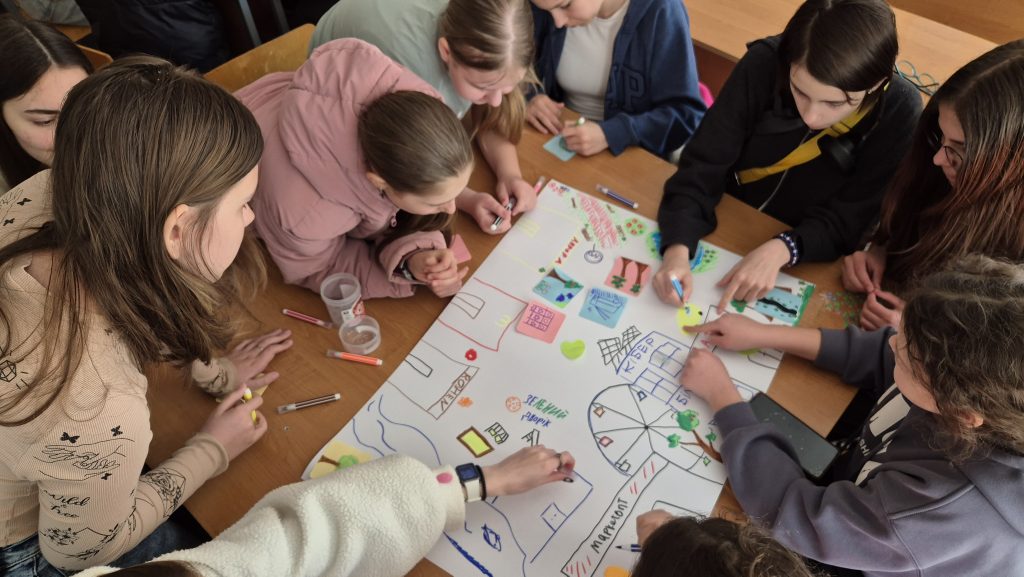
The project began with a conversation about the city and its future. During a workshop with urban planners Semen Verkhohliadov and Anton Volovych, participants discussed the environmental challenges facing Bila Tserkva: the state of the Ros River, green zones, soils, waste management, transport, and the city’s impact on the environment. But the task wasn’t simply to name the problems. Students formed teams and tried to imagine what Bila Tserkva could look like in 2050 — and what solutions would be needed to make the city more sustainable and comfortable to live in.
One of the tasks for the “Green School” participants in Bila Tserkva — to draw what the city of the future will look like
Among the ideas proposed: natural stormwater management systems, rain gardens, the development of convenient electric public transport, and the preservation and connection of green areas into a unified network. This was participants’ first chance to look at the city not just as residents, but as people capable of influencing what it will become in ten, twenty, or thirty years. It was also important to show that major urban changes are made up of many local decisions — some of which can begin right on school grounds.
Organic Waste That Doesn’t Become Rubbish
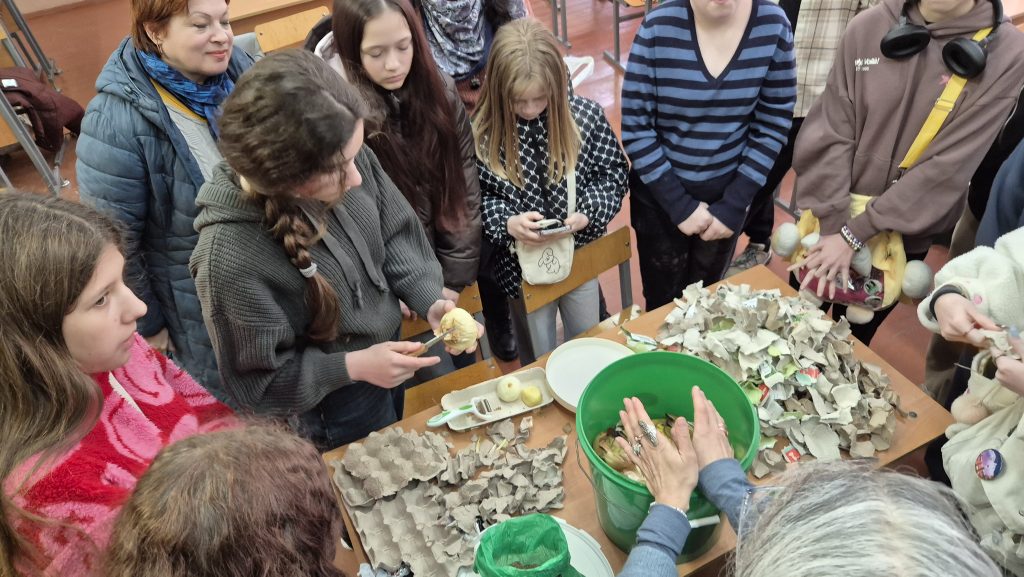
One such practice was composting. A significant portion of household waste is organic: food scraps, vegetable and fruit peelings, leaves, and other materials of natural origin. When mixed in with other waste and sent to landfills, they lose their chance to return to the natural cycle. During a session with Nataliia Haietska, head of the NGO “Mariupol Zero Waste”, participants explored what happens to organic waste and how it can be handled differently.
At the masterclass by Nataliia Haietska, NGO “Mariupol Zero Waste”
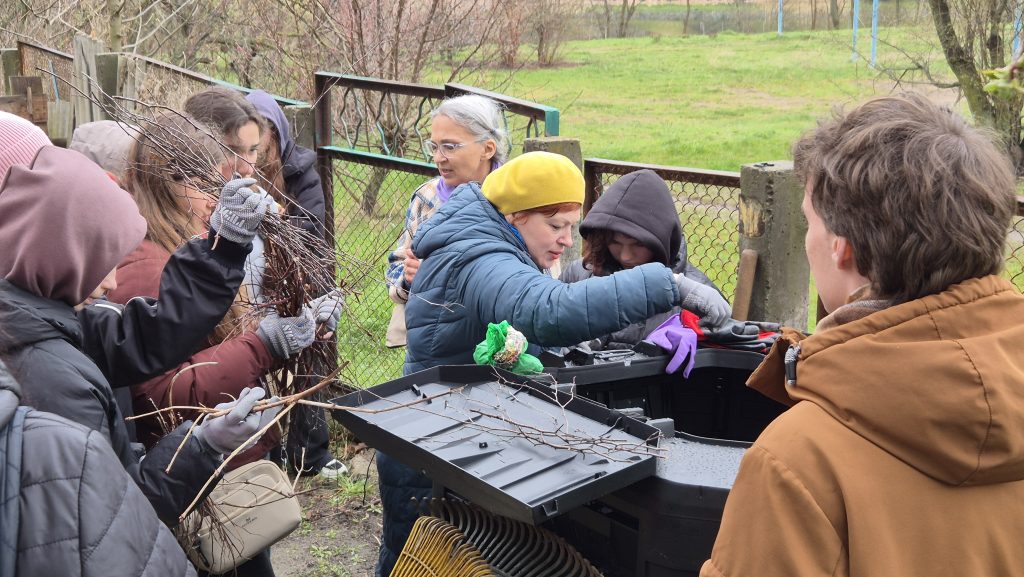
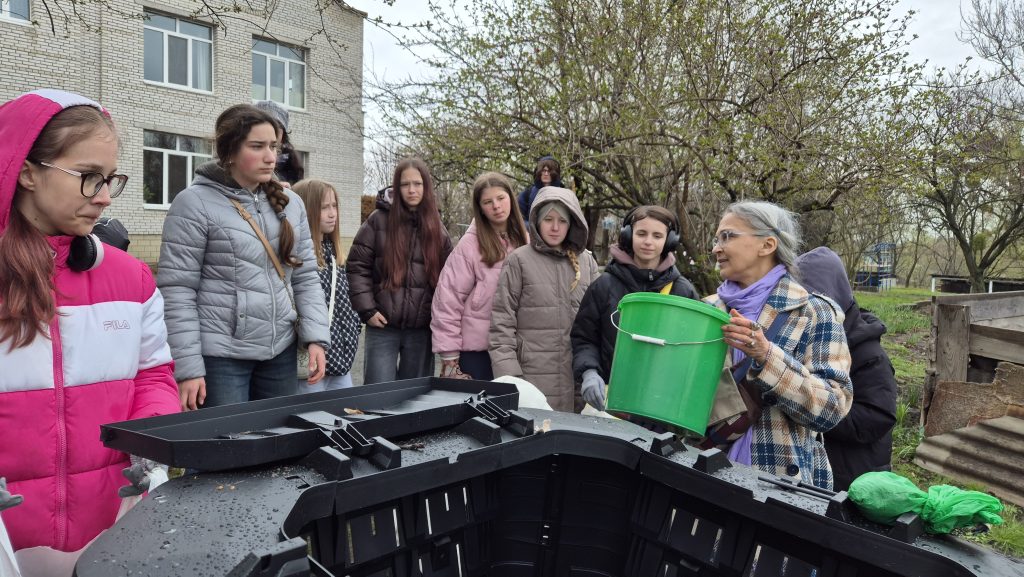
Students learned about various composting methods, including the use of EM buckets and bokashi, and after the theory moved on to practice — launching outdoor composting on the grounds of a preschool education facility. It is a small intervention, yet one that clearly illustrates the principle of circularity: what is usually seen as rubbish can become a resource.
Outdoor composting with Nataliia Haietska
Organic waste doesn’t need to be taken to a landfill — after composting, it becomes material that can be used to tend flower beds and other green spaces. For an educational institution, it is also an opportunity to turn an eco-practice into an ongoing learning process: students can observe it, maintain the composting, and see its results right on their own grounds.
Nataliia Haietska’s talk on outdoor composting
A Tree as Part of Urban Infrastructure
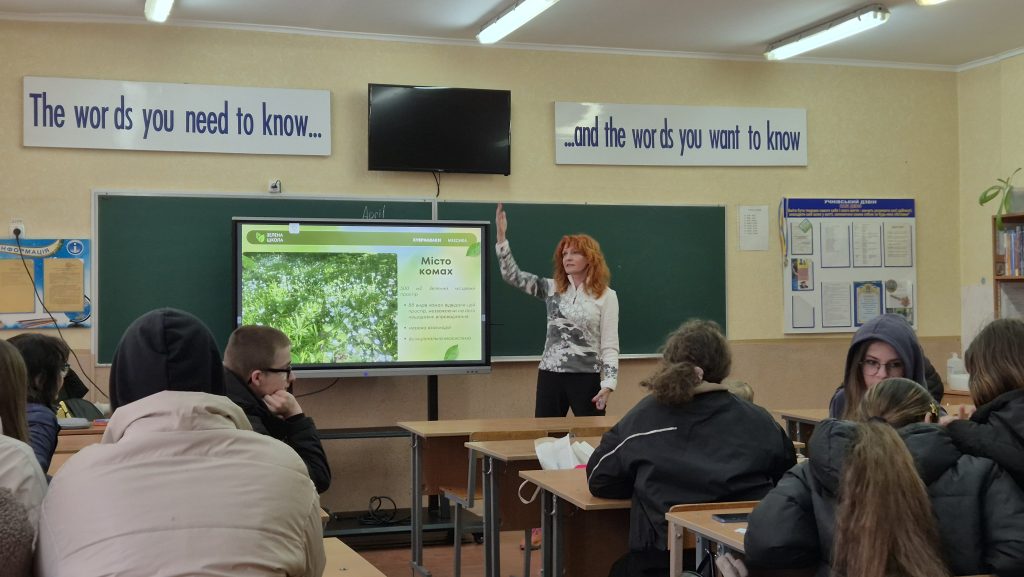
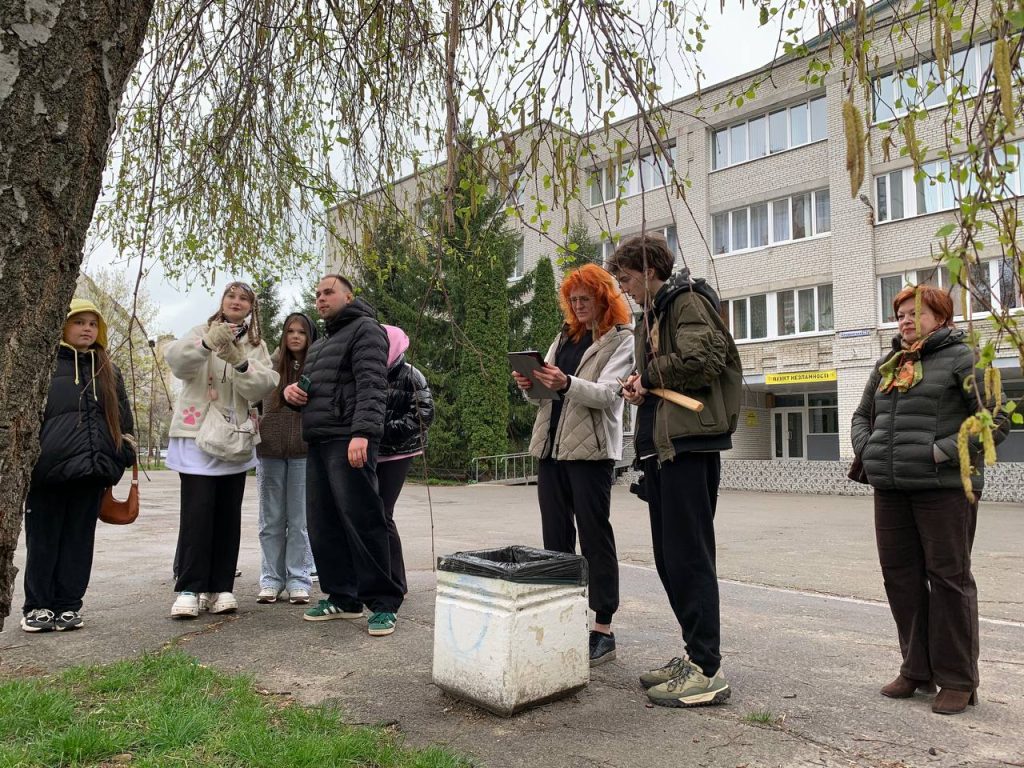
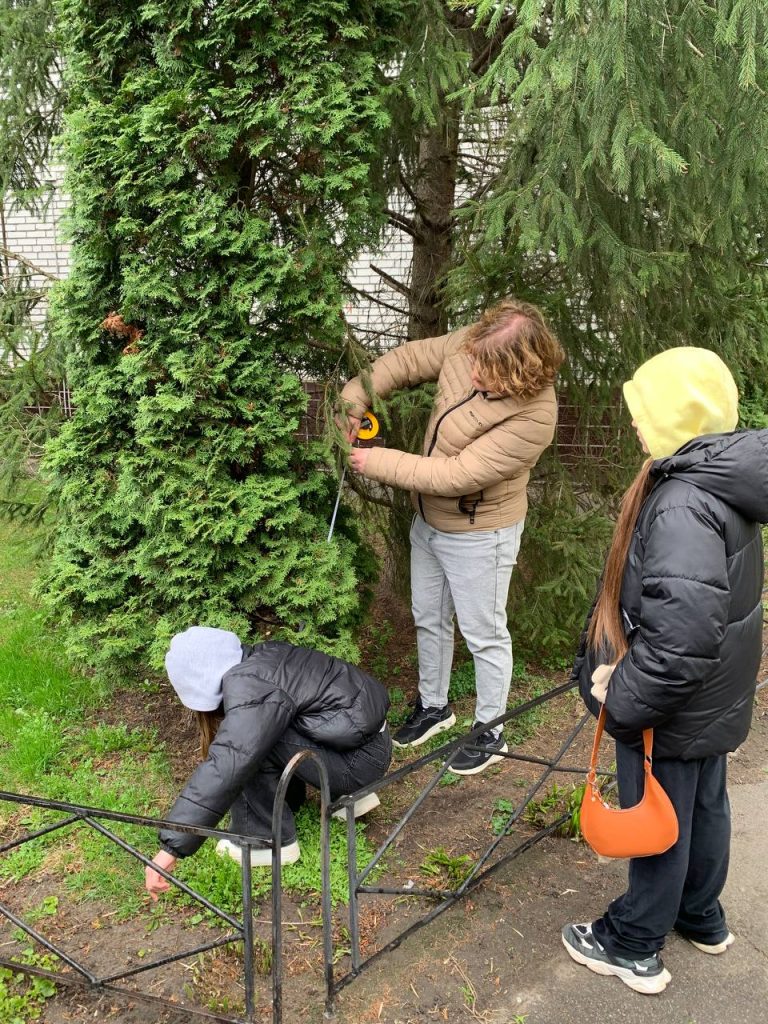
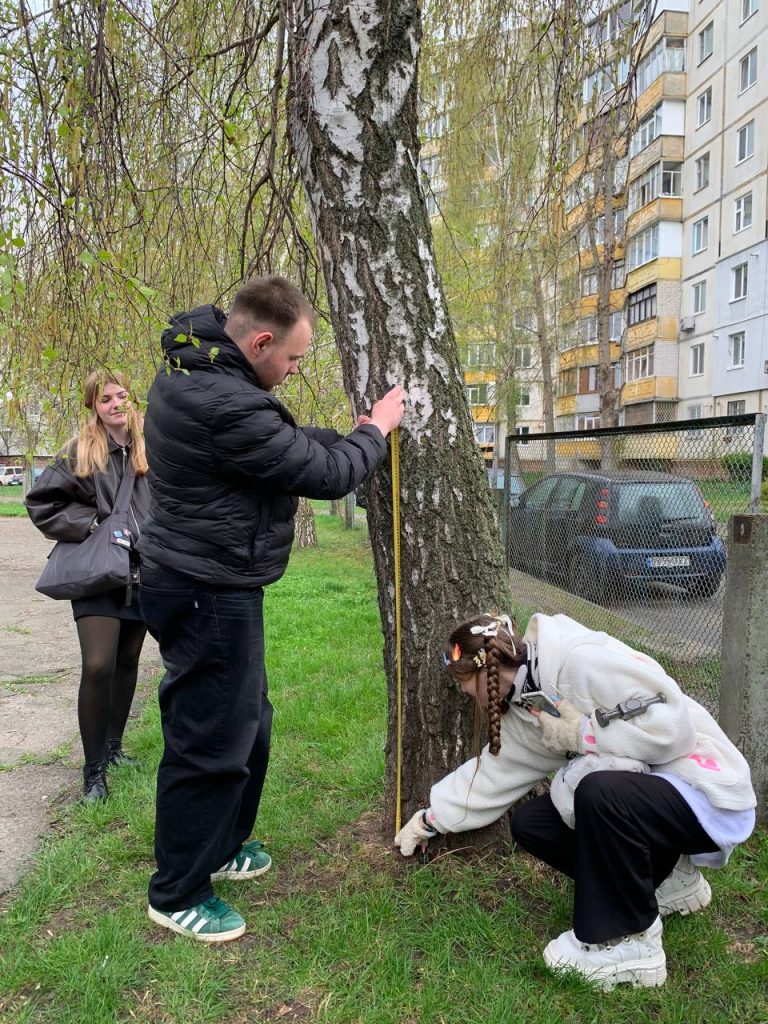
Another module of “Green School” focused on urban trees. Their value is usually hard to see in numbers. A tree provides shade, retains water during rainfall, absorbs carbon and pollutants, lowers the surrounding temperature, and creates a more comfortable urban environment. Yet most of these functions remain nearly invisible to people. Together with geographer Mykola Stavnychyi, participants learned to assess trees and the ecosystem services they provide.
На лекції Миколи Ставничого про міські дерева
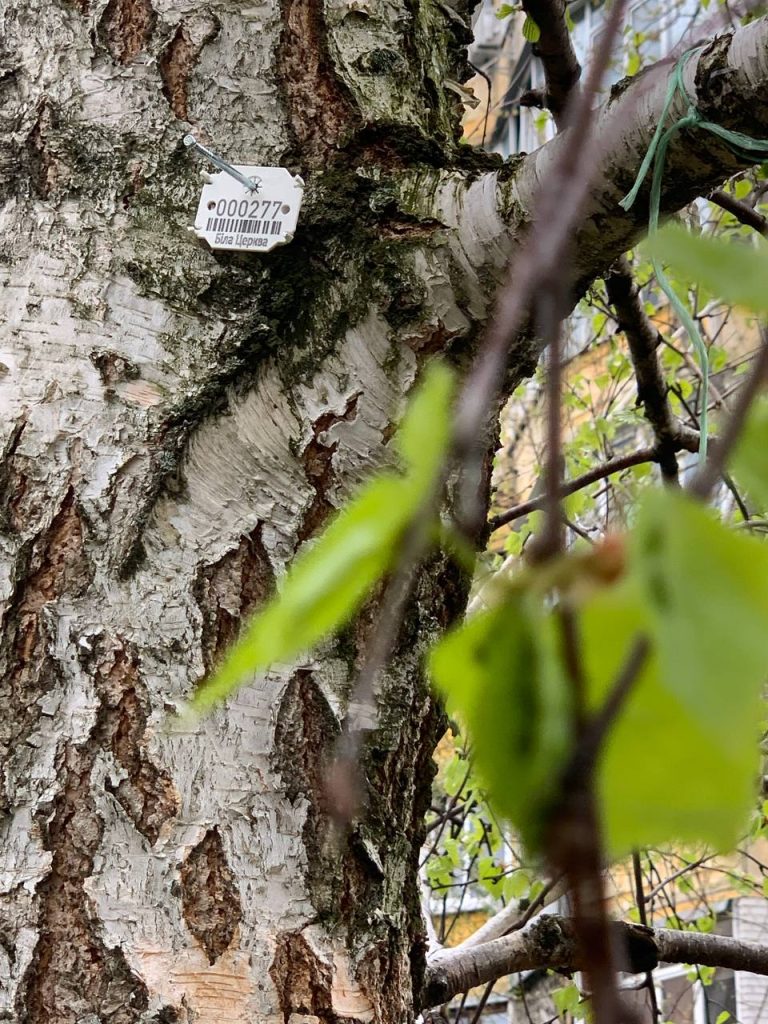
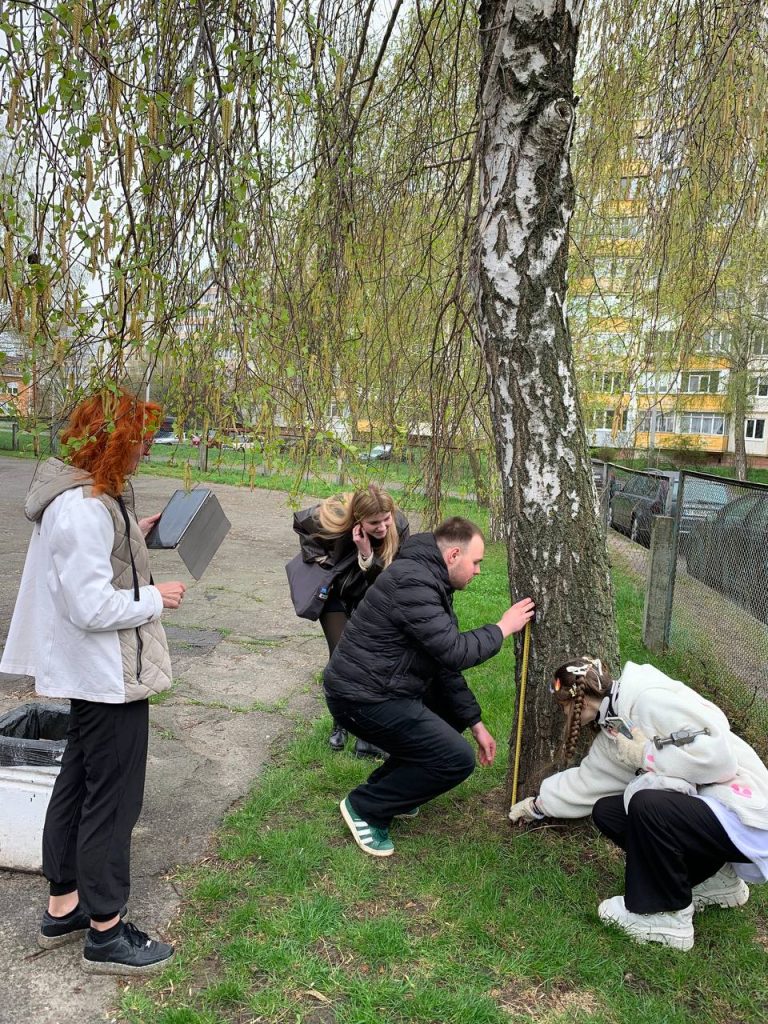
Students went out onto the school grounds and began working as researchers: identifying tree species, measuring trunk and crown parameters, and entering the data into i-Tree tools. Such calculations allow for an approximate estimate of how much rainwater a tree can retain, how much carbon it stores, and what contribution it makes to air purification.
And this changes the way we perceive it. A tree is both an element of landscaping and a part of urban green infrastructure that performs entirely measurable work every day.
From Knowledge to Their Own School Space
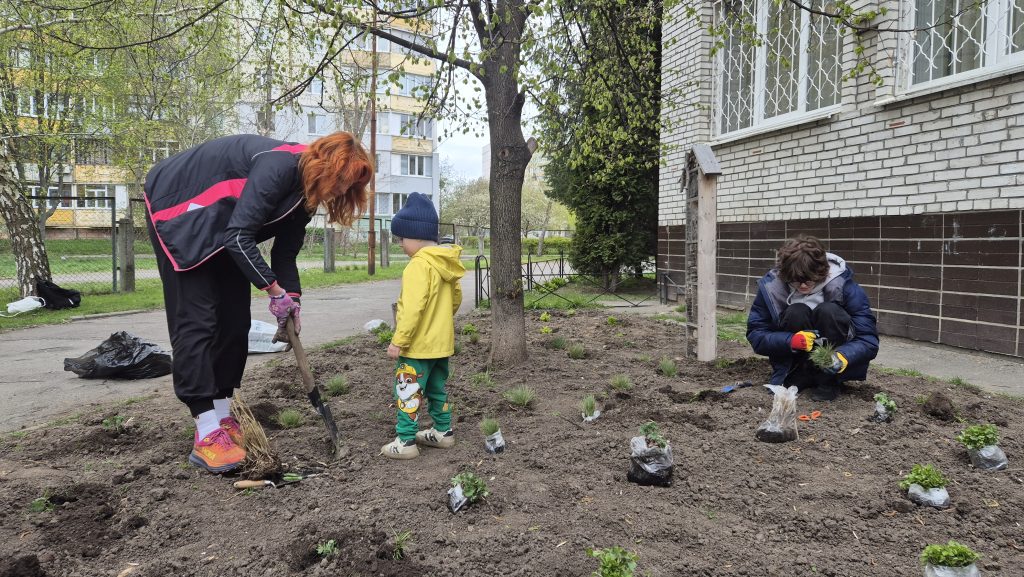
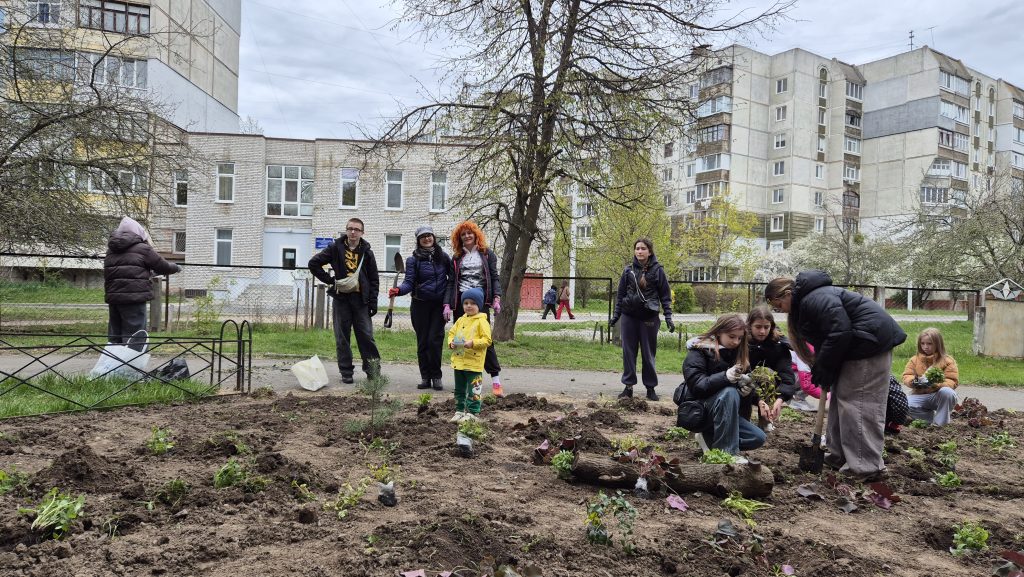
“Green School” is structured so that every topic has a practical follow-up. The project therefore didn’t limit itself to lectures and workshops. Its outcomes are also meant to include physical changes on the grounds of educational institutions. Alongside composting, participants worked on creating and developing green spaces.
Environmental arrangement
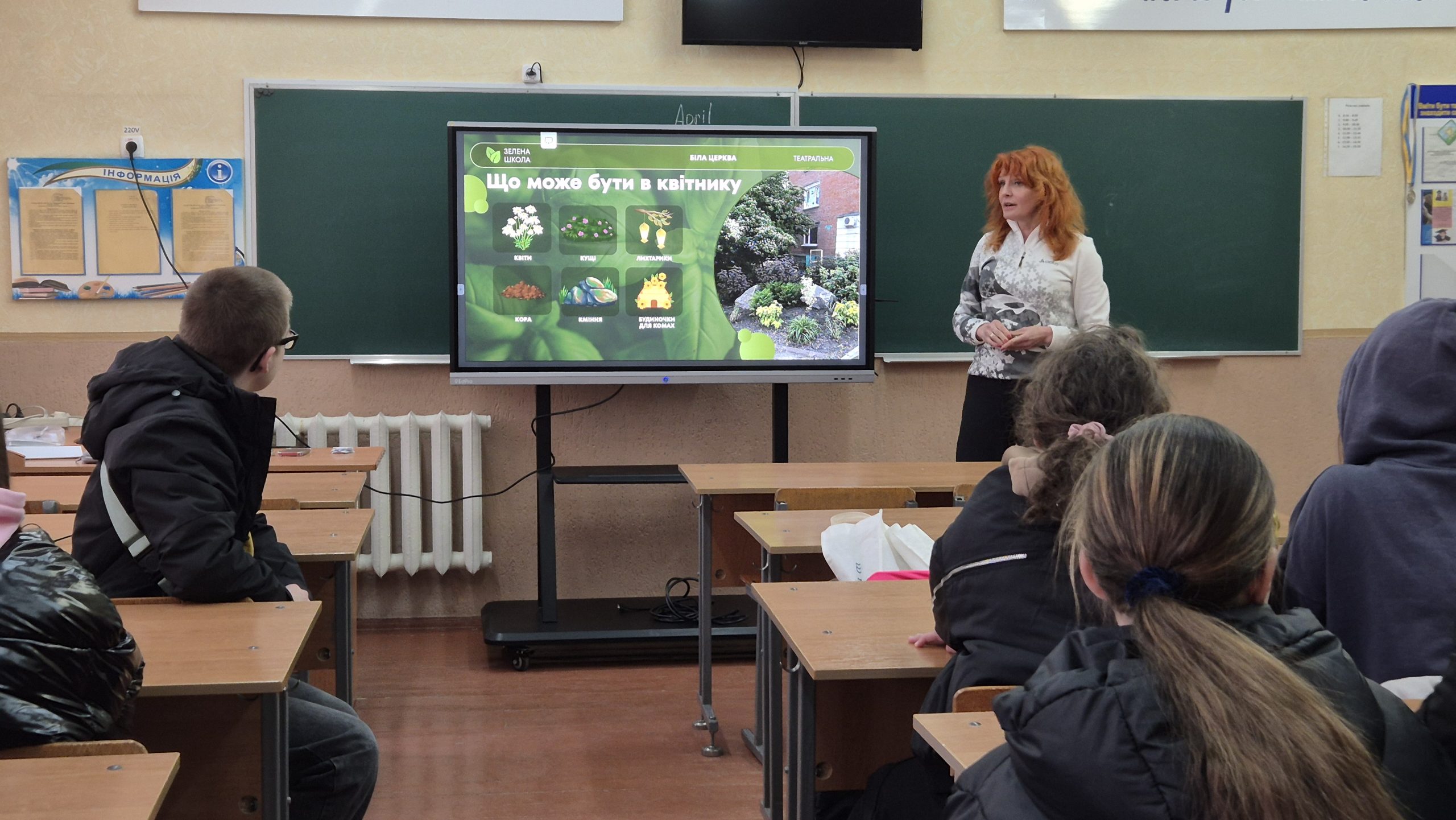
Flower beds with perennial plants and an insect hotel for pollinators appeared in the school yard. The school is gradually becoming a kind of open-air laboratory — a place where one can hear about biodiversity, climate adaptation, or the circular use of resources, and see these principles at work in real life. Aliona Kolotnytska, founder of the MBF “Misto Park”, who works on issues of quality urban environments and community involvement in their development, also joined the work with young people. Students thus had the opportunity to speak with people who work with urban planning, ecology, waste, data, and public spaces in their professional lives.
Lecture on environmental arrangement
What Comes After the Project Ends?
One of the key principles of “Green School” is to create results that don’t disappear immediately after the final workshop. Composters and new green elements created by participants during the practical sessions remain on the grounds of the educational institutions. Teachers will be able to continue using the experience gained with other students. But no less important is what remains in the participants themselves.
Over the course of the project, they journeyed from discussing global environmental problems to working with a specific tree, a composter, and a piece of their school yard. And this is the core idea of “Green School”: to show that change in a city doesn’t always begin with large budgets and large-scale programmes. Sometimes it begins with a simple question: what can we change here and now?The Krokivnia team is working to ensure that the “Green School” project continues, making it possible to engage even more young people and spread awareness of even more topics related to the sustainable development of our communities. You can access materials and learn more about the project here: https://www.krokivnia.org/projects/greenschool Publication prepared by: Anton Volovych, urban planner, NGO “Krokivnia” Follow the Instagram page: https://www.instagram.com/krokivnia