
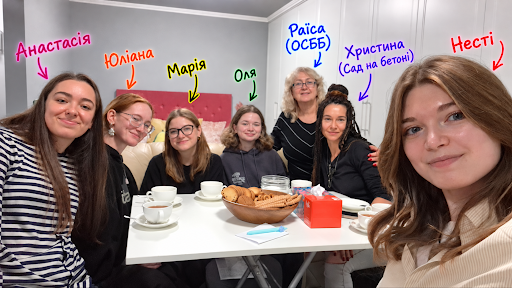
A garden near your home can begin with very different desires. Some want to transform a neglected courtyard, others want to bring nature back to the city or find peace in working with the soil. And some simply enjoy growing plants and watching them thrive.
In almost every city neighbourhood there are neglected courtyards, forgotten patches of land, and places we pass by every day without noticing. Every such place can become a garden, if there are people willing to care for it.
“Garden on Concrete” brings these desires together around a shared purpose: creating local urban gardens together with the people who live nearby.
I founded this initiative after a simple clean-up of a neglected plot next to my own building gradually grew into the creation of a community garden. Today I want to spread this experience to other urban spaces.
The initiative aims to develop a network of small green hubs in Kyiv. We are interested in places that are easy to overlook: courtyards, patches of land between buildings, spots along the daily route to the shop. Where people are used to simply walking past, there can be a reason to stop.
Each garden will have its own character depending on the place, its history, and the needs of its residents. It might be a natural garden for birds and pollinators, a quiet garden for solitude, a kitchen garden that residents create and tend together, an urban mini-forest, or a therapeutic garden for restoration. What unites them is care for nature and people.
How a Courtyard Clean-Up Became a Shared Endeavour
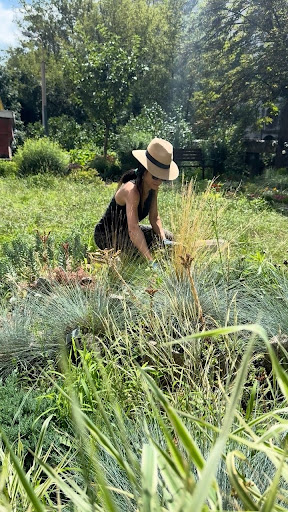
The story began in 2022 on Richkova Street, 3. Before the full-scale war, I had no interest in gardening — I didn’t even have houseplants. Then I started clearing a neglected plot next to my building. After pipe repairs, a pit had been left there, filled with branches and rubbish.
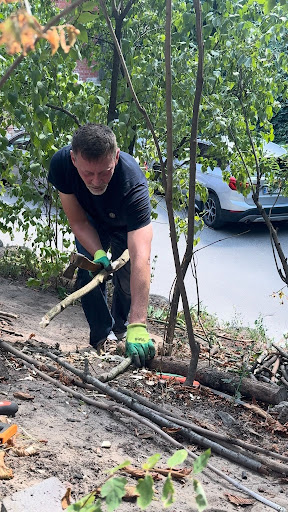
There was no idea of a garden yet. I wanted to be alone, to keep my hands busy with routine work and release difficult emotions. Physical labour helped me feel that at least this small space was something I could influence. There was something therapeutic in it, and at the same time something like a creative act — the ability to change the environment around me with my own hands. Along with this grew a desire to create something that would last and have a continuation.
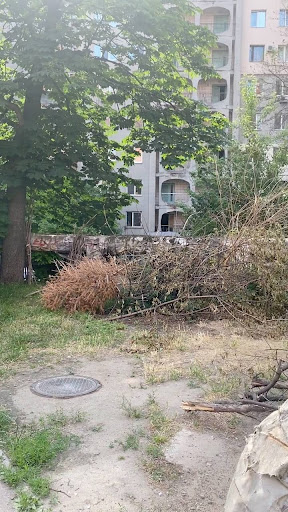
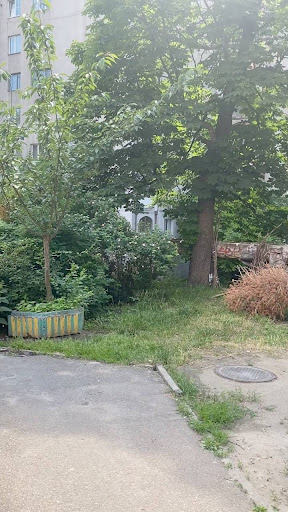
Gradually, neighbours began to join me: they helped with the clean-up, brought plants from their dachas, asked what was going to happen here. This is how the idea of a garden was born from a simple clean-up — an idea that captured others too. Joint clean-up days brought residents closer together, and the homeowners’ association supported the initiative and funded the construction of pathways.
Gradually the neglected plot was transformed into a garden that residents continue to tend and develop. In May 2024, it won a competition for the best residential area among homeowners’ associations. And the experience of creating it became the starting point for work on new urban gardens.
![the garden on Richkova Street, 3 today]](https://zelenval.org/wp-content/uploads/2026/11/1richkova_22_zaraz-1.jpg)
![the garden on Richkova Street, 3 today]](https://zelenval.org/wp-content/uploads/2026/11/richkova_22_zaraz-2.jpg)
![the garden on Richkova Street, 3 today]](https://zelenval.org/wp-content/uploads/2026/11/2richkova_22_zaraz-1.jpg)
Everyone Has Their Own Way to Get Involved
You don’t need specialist knowledge to take part in creating a garden — you can learn as you go. On Richkova Street, some bring seedlings, others support with donations, help with care, or come to community work days. From these contributions, a space has gradually grown that people feel is their own.
This is exactly how “Garden on Concrete” aims to create local gardens together with residents — taking into account the particularities of each place, the needs of the people, and the possibilities of shared care.
Future gardens may combine art, urban growing, shared meals, learning, and everyday rest. It is important to leave room for both meeting and solitude. Some will want to plant and tend, while others will simply come to enjoy the blossoms.
After all, a garden is not only a place where we do things. It is also a space for contemplating beauty, where you can do nothing, simply be and notice the life around you.
Zolotoustivska and Podil
The initiative is currently looking for opportunities to create a community garden at Zolotoustivska Street, 46. This plot is already a focal point for locals: people come to the playground from neighbouring streets, residents walk their dogs here, and many people pass through daily on their way to the shops. The project aims to make this space greener and more comfortable for those who use it.
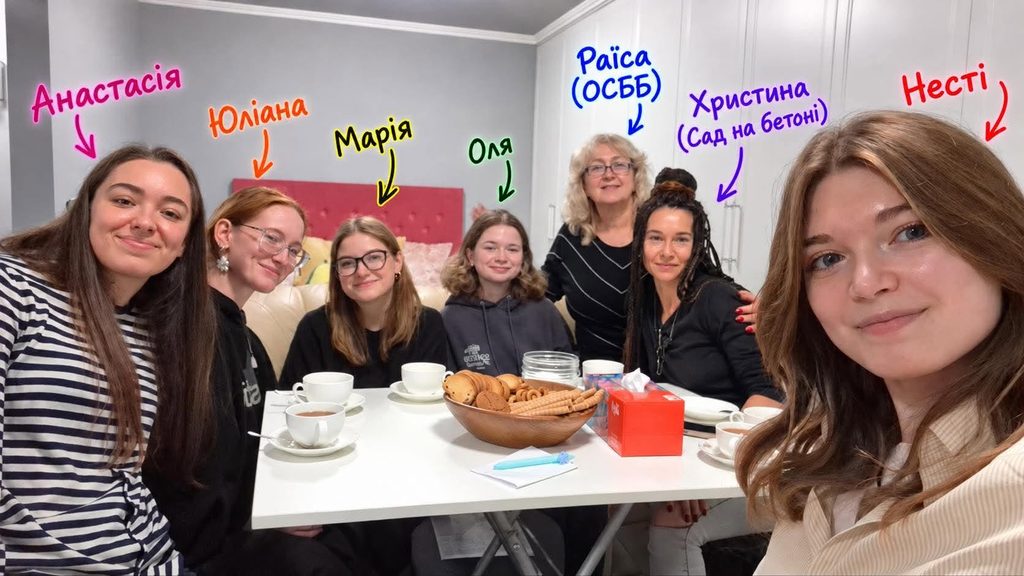
Seven students interested in urbanism and wanting to create change in the city have joined the project. In two weeks, the team developed a concept for a climate-adaptive public space, prepared a budget estimate, and gathered 116 signatures from local residents in support of the project. The application was submitted for a Kyiv Climate Hub grant. A decision is expected in November 2026.
Also in development is a Therapeutic Garden project on Prytyssko-Mykilska Street in Podil, in partnership with NGO “Prytyssko-Mykilska”.
A Culture of Gardeners
Behind the idea of “Garden on Concrete” is a simple thought: we create conditions for potential to unfold.
A gardener does not create a plant or determine what it should become. They care for the soil, light, moisture and space, and take into account the neighbouring plants. They observe, support, sometimes intervene, and sometimes simply stay out of the way.
In a garden, different species may compete, crowd each other out, or coexist and support one another. This is a living metaphor for relationships between people, cultures, and communities. Diversity does not always mean harmony, but under favourable conditions it becomes a source of resilience and beauty.
The same applies to work with communities: it is important to hear different people, understand their needs, and create opportunities for each person to get involved in their own way.
For us, a garden is not only a space for people, but also part of the urban ecosystem. There is room here for birds, pollinators, and wild plants. Preserving old trees, supporting biodiversity, and using rainwater help return natural processes to the city. Even small gardens can become green islands that support ecological connections between larger green areas.
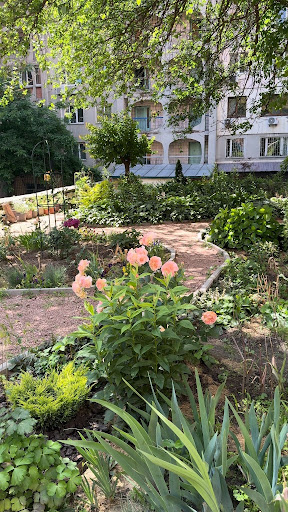
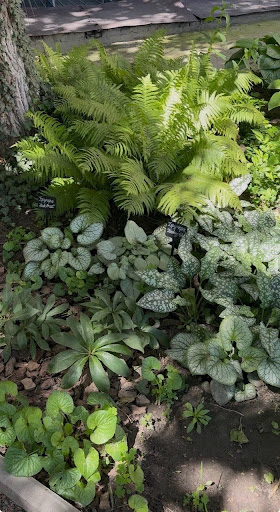
At the same time, creating a garden is an artistic act. Unlike many other works of art, a garden is never finished. It changes with the seasons, grows, ages, sometimes exceeds the bounds of our intention. We can guide its development, but we cannot fully control life.
Gardening can also be a way of ordering one’s own thoughts. By observing plants, we begin to notice the beauty of the ordinary, to value impermanence and accept imperfection.
In a world where we are accustomed to quick results, a garden offers a different way of relating to time. To plant a tree is to care not only for today, but for those who will come after us.
A culture of gardeners begins with simple actions: plant something new, preserve something old, make room for the wild, share knowledge. Not to conquer nature, but to learn to live alongside it.
The goal of “Garden on Concrete” is for the phrase “let’s go to our garden” to become ordinary in different neighbourhoods of Kyiv. So that within a few minutes from home, everyone can find a green space that has room for both nature and their own desires.
We create gardens as an act of faith in the future, even when it seems uncertain.
Because a garden is a place where hope stops being an abstraction and takes root.
Written by: Khrystyna Vinter, founder of the “Garden on Concrete” initiative, urban greening project manager.
Follow on Instagram: instagram.com/sad_na_betoni